Case Study: When Audits Said “All Clear,” Workers Told a Different Story
Updated: Aug 11
A Labor Solutions Case Study
Case Study Snapshot
Client: Global electronics company
Scope: 50+ Tier-1 & Tier-2 sites (India, Vietnam, Romania, Malaysia)
Method: The WELL Worker Survey deployed via the WOVO Dashboard
Why: Validate audit findings + gain between-audit visibility
Key findings:
35% sites: workers reported illegal recruitment fees
27% sites: low engagement/mistrusted grievance mechanisms
Additional risks: retaliation concerns, supervisory misconduct, harassment, hours
How the WELL Survey Uncovered Hidden Risks Missed by Audits in Over 50 Electronics Sites
A multinational electronics company deployed the WELL Survey across more than 50 sites that had already passed traditional social audits. The goal was to compare audit findings with direct worker experience.
The Challenge
Positive Audits, Lingering Doubts
Although audit results suggested strong compliance, the brand suspected critical gaps in visibility. Across sites, grievance channels varied widely, worker trust in reporting mechanisms was low, and audit interviews were failing to surface systemic issues—particularly around recruitment fees.
The brand needed a way to validate audit findings and gain “between-audit” visibility into real, day-to-day risks experienced by workers.
Our Solution
Deploying the WELL Worker Survey at Scale
Labor Solutions implemented the WELL Worker Survey—a worker-centric, globally consistent human rights survey designed to capture lived experience while remaining sensitive to regional risk.
The survey combined standardized core indicators for cross-supplier comparability with localized modules tailored to country-specific risks. Questions were experience-based and written in clear, worker-friendly language to encourage trust and honest participation.
Labor Solutions provided full deployment support across all countries, with real-time analytics delivered through the WOVO Engage Dashboard. WOVO Engage Dashboard
Results:
The WELL Survey Revealed Significant Issues that Audits had Entirely Missed.

Despite strong audit performance, the WELL Survey exposed systemic risks that audits had failed to detect in almost every supplier.
What audits missed (worker-reported):
At 35% of sites, workers reported paying illegal recruitment fees—issues that audits had failed to detect.
At 27% of sites, low worker engagement pointed to unclear or mistrusted grievance mechanisms.
Reported barriers: fear of retaliation, inaccessible channels, supervisory misconduct, harassment, working hours risks.
These insights enabled targeted remediation planning and faster prioritization across the supply base.
Actions
Moving Data into Real Impact Fast
Actions taken
Results reviewed in real time in the dashboard (heatmaps / supplier comparisons)
Findings shared with sites immediately
Brand launched supplier self-diagnostic + action plans
Real-Time, Actionable Insight Through WOVO Dashboard
Using the WOVO Dashboard, the brand accessed survey results in real time as surveys were launched simultaneously across countries and languages. This provided immediate visibility into priority issues, risk levels across sites, and patterns across sites, regions, and supplier tiers—visualized through intuitive heatmaps and dashboards.
With worker-level insights that had previously been inaccessible, the brand moved quickly from data to action. Findings were shared directly with sites, enabling targeted remediation within days rather than after the next audit cycle. As a result, the brand initiated site self-diagnostics and action plans to address identified risks.
Immediate Impact + Remediation
As a result, the brand was able to:
Identify high-risk sites within days, not months
Launch targeted remediation plans faster
Compare risks across regions and supplier tiers
Equip sites with actionable, worker-backed insights
Using worker-level insights that were previously inaccessible, the brand has decided to conduct site self-diagnostic and action plans, using the WELL Cycle.
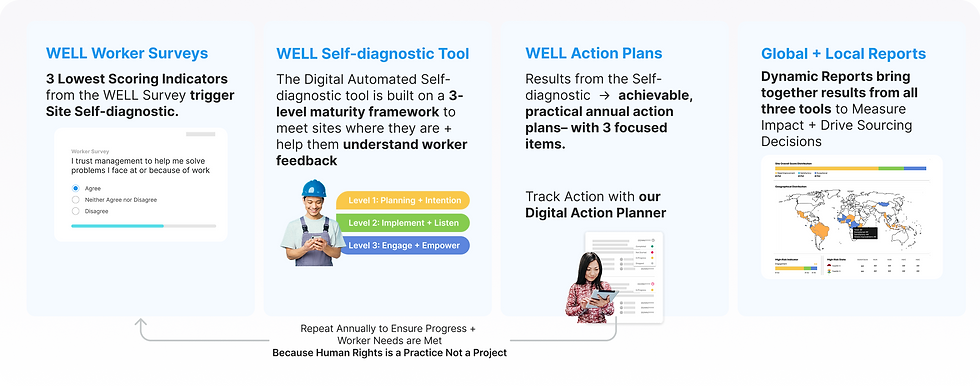
This project demonstrated that even well-established audit programs can miss systemic, persistent issues—and reaffirmed that worker-driven data is essential to effective, modern due diligence.
Why it Worked
How the WELL Survey Turned Worker Voice into Comparable, Country-Specific Intelligence
Global Consistency, Local Relevance
The WELL Survey provided a standardized global structure covering core human rights topics—health and safety, access to remedy, harassment and abuse, and worker engagement—while allowing tailored indicators based on regional risks:
Working hours focus for China
Responsible recruitment for Malaysia and Romania
Working environment and supervisory conduct for India
This combination ensures comparability across countries and actionable insights within each region.
Worker-Centric, Industry-Refined Questions: Revealing the Reality Behind Compliance

Unlike audits, the WELL Survey relies on neutral, experience-based questions written in clear language and supported by scenario prompts. This approach helps workers reflect on real situations and share feedback they may otherwise withhold—revealing issues that often remain invisible during formal interviews.
Deployment Support That Ensured High Engagement + Powered True Insights
Labor Solutions managed the full rollout across all sites, onboarding each site in local languages and launching surveys simultaneously across regions. Workers participated anonymously via QR codes, increasing trust and response quality.
Responses were analyzed and visualized in the WOVO Dashboard, allowing the brand to quickly spot patterns, compare sites, and prioritize action.
Real-Time, Actionable Insight Through WOVO Dashboard
The brand’s team accessed results instantly via the WOVO Dashboard, enabling them to launch surveys simultaneously across multiple countries and languages to gain immediate visibility into:
Priority issues across countries
Visualize risk levels through a supplier heatmap
Compare priority issues across sites and regions
Share insights directly with sites for follow-up
This enabled action plans within days, not after the next audit cycle.
What this Case Study Shows
From Audit Validation to Continuous, Worker-Driven Due Diligence
Audits can validate documentation and controls, but they may not capture lived experience — especially on sensitive issues like recruitment fees or fear of retaliation.
Worker-reported data adds a complementary layer of risk visibility.
Between-audit visibility changes the operating model from periodic compliance to continuous risk detection.
Real-time survey feedback can surface systemic issues early and guide faster interventions.
Standardization enables comparability across sites, while localization ensures relevance.
A consistent core survey paired with country-specific modules supports both global oversight and local action.
Trust and participation are the signal—not just the outcome.
Low engagement can indicate mistrusted or unclear grievance mechanisms, which is itself a due diligence risk worth addressing.
Actionability matters more than data volume.
When results are delivered in a format teams can interpret quickly (heatmaps, supplier comparisons), it becomes easier to prioritize remediation and engage sites immediately.