Worker-Driven Due Diligence Is Not a Project. It's a Practice.
Updated: Sep 17
What CSDDD actually requires — and why the brands getting it right run a cycle, not a checklist.
CSDDD does not use the word "audit." It does not require a one-time systems assessment or a point-in-time review. The word it uses — in Article 8, in Article 9, throughout — is "ongoing." Ongoing risk identification. Ongoing worker engagement. Ongoing access to remedy. Ongoing documentation of what you found and what you did about it.
That word carries a structural implication that most compliance teams have not yet fully absorbed: you are not building a system. You are building a practice. And a practice, by definition, repeats.
The difference between a project and a practice is not intensity or cost. It is what happens in Year Two. A project ends. A practice compounds. The brands that will have the strongest CSDDD evidence base in 2027 are not the ones that deployed the most tools in 2025. They are the ones that started their annual cycle early enough that they have multiple turns of data to show.
Worker-Driven Due Diligence (HRDD) is the operating model that makes "ongoing" a reality — not a declaration of intent, but a documented, repeating cycle of listening, diagnosing, acting, and evidencing. This is what it looks like in practice.
Worker-Driven Due Diligence in practice: four stages, run in sequence, every year.

Stage 1: Workers tell you what audits can't.
The WELL Worker Survey (Wellbeing, Engagement and Livelihoods) reaches workers directly — in their language, through channels they control, with anonymity that is credible because it is structurally guaranteed, not just promised. Workers share what they actually experience: wages, safety, management behavior, hours, recruitment. The survey runs across the supplier base simultaneously. You get a dataset, not a snapshot.
Stage 2: Suppliers diagnose root cause.
WOVO IMPROVE gives suppliers a self-assessment tool built around what workers indicated. The supplier does not receive a corrective action plan imposed from outside. They work through what their workers said, identify the root causes they can actually address, and build an action plan they own. Priorities are capped at three — because a list of forty corrective actions is not accountability. It is paralysis.
Stage 3: Action plans generate evidence.
Targeted action plans based on worker signals and the self-assessment are tracked over time. WOVO EDUCATE delivers rights-based digital training to workers and managers. WOVO CONNECT — an always-on operational grievance mechanism, not a hotline — remains open throughout the year so workers can raise concerns between survey cycles. All of this generates a documented trail: what was found, what was done, what changed.
Stage 4: Reports make it producible.
Global and local reports aggregate the data from every stage. Risk indicators. High-risk suppliers. Cohort trends. Supplier-level progress on action plans. Worker satisfaction scores over time. This is the documentation CSDDD Article 10 requires — and the evidence ESRS S2 reporting standards ask brands to disclose publicly.
Then the cycle repeats. Annually. Because human rights is a practice, not a project.
What the cycle reveals that no single deployment can
The case for running an annual cycle rather than a one-time engagement is not philosophical. It is evidentiary.
A seafood industry pilot using the WELL Survey found — in its first cycle — what no prior supplier reporting or audit had surfaced: debt bondage linked to local recruitment agencies, excessive hours, harassment and psychological safety concerns, and water and occupational health and safety issues across geographies. Ninety-two percent of workers participated. Eighty-seven percent of farmers participated. Thirty-eight thousand respondents across three languages. Zero prior visibility through conventional channels.
That is what a first cycle surfaces. But a first cycle does not tell you whether conditions improved. It does not give you a baseline to measure against. It does not tell you which suppliers are responding to their action plans and which are not. It does not give you the trend data CSDDD requires as evidence of ongoing engagement. The second cycle does that. So does the third.
In the electronics sector, Labor Solutions' WELL Survey found that 35% of suppliers who had passed recent social audits had workers paying illegal recruitment fees — a serious forced labor indicator. Seventy-three percent of workers in that same cohort had low awareness of their rights. Both findings required a second cycle to begin measuring improvement. The first cycle is necessary. It is not sufficient.
What changes when suppliers own their improvement
The structural difference between a corrective action plan (CAP) and a worker-driven action plan is ownership. CAPs are issued from outside. Supplier self-assessments are built from within — starting with what workers said, worked through by the people who have to implement the changes.
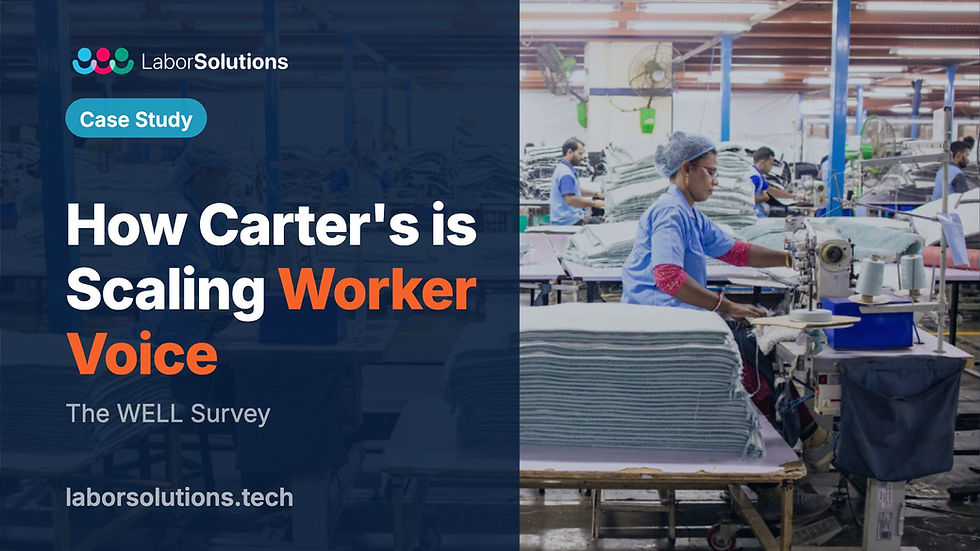
Carter's deployed the WELL Survey across 65,000+ workers in 24 suppliers across five countries — Bangladesh, Vietnam, Ethiopia, Thailand, and Cambodia. The decision to move beyond audits reflected a recognition that audit data was not telling them what was happening to workers in their value chain.
Crucially, Carter's integrated WELL Survey scores into their Vendor Scorecard — embedding worker experience data into the sourcing decisions that suppliers actually respond to. When worker voice data has commercial consequences for the supplier relationship, supplier engagement in the improvement cycle is not optional. It is structural.
That integration — worker survey findings into commercial accountability — is the operational definition of a Worker-Driven Due Diligence programme. It is also what CSDDD expects: that the findings of ongoing engagement with workers have consequences, and that those consequences are documented.
One year of data satisfies the minimum. Three years is what holds up under ESRS S2 scrutiny.
CSDDD Article 10 requires companies to produce documented evidence of what they did to prevent and mitigate human rights risks — and what changed as a result. This is not a policy question. It is a data question. And data accumulates over time, not at deployment.
ESRS S2, which governs how companies subject to CSRD must report publicly on their value chain worker engagement, requires disclosure of: the channels through which workers can raise concerns; the effectiveness of those channels; the company's approach to due diligence; and the outcomes of that approach. A company reporting in 2026 with one year of data reports minimally. A company reporting with three years of trend data reports compellingly.
The brands that will satisfy ESRS S2 scrutiny are not those that deployed the best tools. They are the ones that deployed early enough to have a story to tell — a story that begins "in Year One, we found this; in Year Two, conditions changed in these ways; by Year Three, satisfaction across our Tier 1 base had moved from this to that." That story requires a cycle. It requires repetition. It requires not stopping after Year One because the results were uncomfortable or the supplier engagement was harder than expected.
WOVO is the platform that makes repetition operationally feasible at scale — 3.8 million active workers, 180+ countries, 41+ languages, deployable across a Tier 1 supplier base as a continuous annual program, not a periodic project.
The compliance posture that actually holds up under scrutiny
When a regulator asks whether your company has engaged workers in its value chain, there are two possible answers. One is: "We deployed a worker survey." The other is: "We have been running a Worker-Driven Due Diligence cycle for three years. Here are the findings from each year, the supplier improvement plans those findings generated, the change in worker satisfaction scores over that period, and the grievance resolution data from the mechanism workers used between survey cycles."
The first answer is a project. The second is a practice. CSDDD is not asking for the first.
Labor Solutions is the provider of the WOVO platform — the only worker engagement tool focused exclusively on value chain workers and suppliers, deployed continuously, in 180+ countries and 41+ languages. The proof points cited in this post reflect confirmed programme data from WOVO deployments across apparel, footwear, electronics, and seafood value chains.
If you are working toward CSDDD compliance
If you are building a worker engagement program ahead of CSDDD obligations, the Carter's case study shows what a structured, multi-country deployment looks like when worker data is integrated into sourcing decisions.
If you are in seafood, agriculture, or food supply chains, the seafood worker voice programme documents what a first cycle surfaces in high-risk migrant worker contexts.
If you need a practical breakdown of what CSDDD requires at each article, the CSDDD practical guide maps each obligation to the evidence standard it demands.
And if you are ready to begin, contact the Labor Solutions team to scope a Worker-Driven Due Diligence program for your value chain.
Frequently Asked Questions
Does running a worker survey once satisfy CSDDD's ongoing engagement requirement?
No. CSDDD requires ongoing worker engagement — not a one-time survey. A single survey cycle establishes a baseline. Ongoing compliance requires an annual cycle of listening, root cause analysis, supplier improvement tracking, and grievance mechanism access between cycles. Single-cycle data cannot demonstrate the trend evidence CSDDD and ESRS S2 require.
What is Worker-Driven Due Diligence?
Worker-Driven Due Diligence (HRDD) is Labor Solutions' framing for human rights due diligence built on continuous, direct worker engagement — as opposed to audit-based models that are point-in-time and externally assessed. It means workers generate the primary data through validated surveys and always-on grievance mechanisms, suppliers own their improvement plans, and brands accumulate longitudinal evidence of what is actually happening in their value chains.
How is the WOVO annual cycle different from a social audit program?
Social audits assess what a supplier built — policies, documented systems, physical conditions — on a specific day. The WOVO cycle generates what workers know: their actual experiences, through channels they trust, continuously. An audit produces a compliance rating. The WOVO cycle produces a dataset that compounds in value every year it is repeated — and that satisfies the ongoing engagement and evidence standards CSDDD requires.
What does CSDDD require as evidence of worker engagement?
CSDDD requires companies to document that they identified human rights risks in their value chains, took action to prevent or mitigate those risks, and can demonstrate the outcomes of those actions. This requires primary worker data (not audit reports), a functioning grievance mechanism with usage and resolution data, documented supplier improvement plans, and longitudinal trend data showing what changed. ESRS S2 adds public reporting obligations for companies subject to CSRD.
How quickly can an annual cycle be established?
The first survey cycle can be deployed within weeks across a Tier 1 supplier base using the WOVO platform. WOVO CONNECT is always-on from the point of deployment. The first full cycle — survey, self-assessment, action plans, and initial reporting — is typically complete within a year, positioning brands to begin their second cycle with a documented baseline and a functioning supplier engagement infrastructure already in place.