Listening at Scale: Worker Voice in Agricultural Supply Chains
Updated: Feb 3
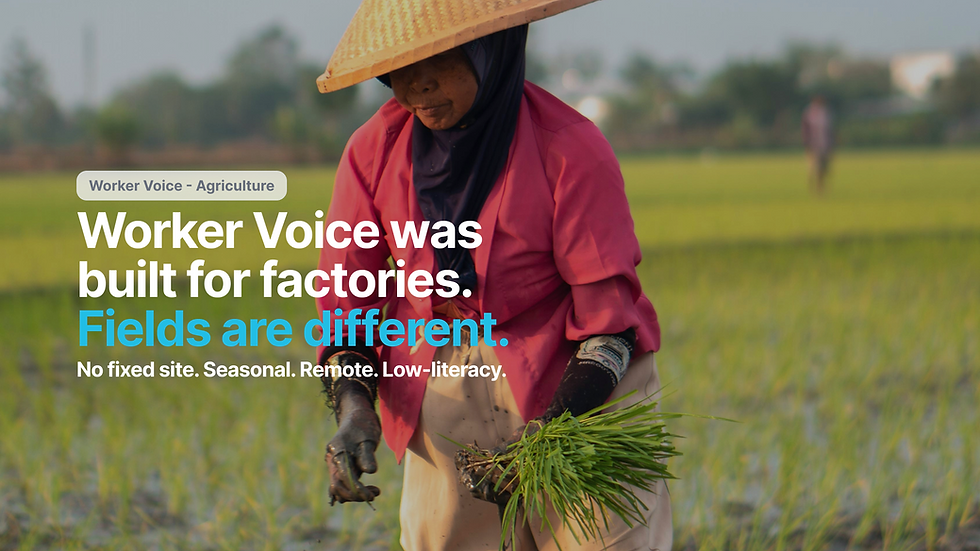
Human rights due diligence in agriculture starts with listening to rightsholders. But listening in agricultural supply chains is fundamentally different from listening in factories or offices. Workers and farmers are dispersed across remote locations, employment is often seasonal or informal, and many face barriers related to language, literacy, and access to technology.

When worker surveys fail to account for these realities, participation drops and critical risks remain hidden. At Labor Solutions, we’ve built a scalable worker-voice model designed specifically for agricultural and food supply chains—one that works in low-literacy, low-tech environments and produces data companies can actually use.
Our approach centers on the WELL Survey and is guided by a simple principle: the survey must fit the worker’s reality, not the other way around.
This principle is embedded into the design of Labor Solutions’ worker technology platform, WOVO. We outline our broader approach to inclusive, low-literacy, and worker-first product design in Designing Worker Technology That Works at Scale.
How We Deploy Worker Surveys in Agricultural Settings
Effective worker voice in agriculture begins with understanding how and where people work. Rather than relying on formal worksites alone, we map farms, collection points, mills, and seasonal gathering locations. Deployment is timed around harvest cycles, market days, and delivery schedules—when workers and farmers are already present and available.

Survey methods are selected based on worker needs and access. In some contexts, workers respond via QR codes or mobile devices. In many agricultural settings, however, human-led, in-person deployment is essential. Labor Solutions staff or trained local deployment leaders support workers directly, explaining what the survey is, why it matters, and how anonymity is protected. Informed consent is actively ensured, not assumed.
Surveys are deployed in locations workers already trust—such as delivery points, community hubs, or health centers—rather than in unfamiliar or employer-controlled environments. Participation is monitored in real time so gaps can be addressed, and the loop is closed by sharing outcomes with supply chain partners to reinforce accountability.
Designed for Low Literacy and High-Risk Contexts
The WELL Survey is designed to be accessible regardless of literacy level. Questions focus on lived experience rather than technical or legal concepts, making them easier to understand and more effective at uncovering hidden risks. Surveys use standardized, tested translations and are supported by images and voiceovers to reduce literacy barriers.
Because many agricultural and migrant workers face literacy and technology constraints, human-led deployment is critical. In-person engagement builds understanding, trust, and participation—key foundations for reliable data. This is also why we do not rely on IVR.
When literacy or access is limited, workers need more support, not more automation. In agricultural and migrant worker settings, IVR consistently leads to confusion, disengagement, and unreliable responses.
When Worker Voice Reveals Hidden Agricultural Risks
In one partnership with a global Food & Beverage brand, Labor Solutions deployed the WELL Survey across remote agricultural supply chains. By aligning deployment with harvest cycles and trusted gathering points, participation reached 92% among workers and 87% among farmers.
The data revealed excessive working hours and insufficient wages across both groups, along with highly localized risks that had not been previously identified. These included debt bondage among farmers linked to local agencies, as well as occupational safety and drinking water concerns among workers in Mexico.
Because these insights came directly from workers and farmers, the company was able to conduct targeted follow-up assessments and implement remediation grounded in worker-verified evidence, strengthening its human rights due diligence.
Migrant Workers Without a Voice—Until Deployment Met Their Reality
In another engagement, a global food company operating across Southeast Asia faced challenges reaching migrant workers. Language barriers, low literacy, and inconsistent phone access meant that existing feedback channels were largely ineffective, despite audit results suggesting compliance.
Labor Solutions deployed the WELL Survey using indicators tailored to migrant labor risks and a mixed deployment approach. On-site support helped workers understand the survey and build trust, while QR codes enabled discreet participation where appropriate. Nearly 60% of workers responded across facilities, demonstrating strong demand for a safe and accessible way to speak up.
The data uncovered overtime coercion risks reported by 85% of respondents—a critical issue that audits had failed to surface. In response, the company strengthened buyer–supplier communication, updated contract terms, reformed incentive and target-setting structures, and delivered targeted management training. Worker committees were upskilled, and grievance mechanisms became more effective and trusted.
Today, the survey is embedded as an annual continuous-improvement tool, enabling earlier detection of forced labor risks and building trust among migrant workers who see that their voices lead to action.
From Listening to Action
Across agricultural and food supply chains, worker surveys only matter if they lead to change. Through dynamic dashboards, companies can see where risks are concentrated, whether issues are isolated or systemic, and how conditions evolve over time—at site, supplier, and global levels.
This is not about collecting more data. It is about generating decision-ready worker risk intelligence that supports proportional, risk-based human rights due diligence.
In agriculture, listening requires intention, adaptation, and human engagement. When done well, worker voice does more than identify risk—it becomes the foundation for credible, effective due diligence.
Ready to move from audits to worker-verified evidence?
Labor Solutions helps companies deploy scalable, low-barrier worker surveys that work in agricultural and low-literacy settings — and turn worker voice into actionable due diligence insights.
Contact us to learn how the WELL Survey can strengthen your agricultural supply chain due diligence.