“It exists” is not “it works”: how an electronics manufacturing site rebuilt worker trust in its grievance mechanism
Updated: 4 days ago
Executive Summary
An electronics manufacturing site had already built what a basic grievance mechanism needs - clear policies, defined channels, documented procedures. The open question was the one that matters most: does it work for workers? At baseline, less than 15% of workers said they clearly understood what happens after a problem is reported to management. Through the WELL Grievance Integrity Program, the site listened to what workers actually experienced, pinpointed where confidence was breaking down, and owned a practical plan to close the gap.
Between baseline and endline surveys, worker confidence rose across every indicator in the Grievance Integrity Extension Program - Grievance Mechanism Accessibility, Grievance Mechanism Process + Transparency, and Communication - and by endline the site met 7 of the 8 UNGP Principle 31 criteria for an effective grievance mechanism. The site turned a mechanism that looked complete on paper into one workers know, trust, and use.
A grievance mechanism can look complete and still fail workers.
Most manufacturing sites arrive at the same point in their human rights work: the policies are written, the grievance channels exist, the procedures are documented. What comes next is harder. Does the mechanism actually work for workers - and if not, which part? Why isn’t it working? And how do you improve it? An audit can confirm a system exists on paper. It cannot tell a site whether workers know how to raise a concern, trust it will be handled fairly, or believe that speaking up changes anything.
There is a further gap. Sites generally know what international standards expect of them - but breaking those standards down into tangible steps they can take in daily operations is difficult. The site wanted to close both gaps: to see clearly how its mechanism was working for workers, and to translate a high-level standard into practical actions its teams could actually carry out.
The WELL Grievance Integrity Program turns UNGP Principle 31 into steps a site can act on.
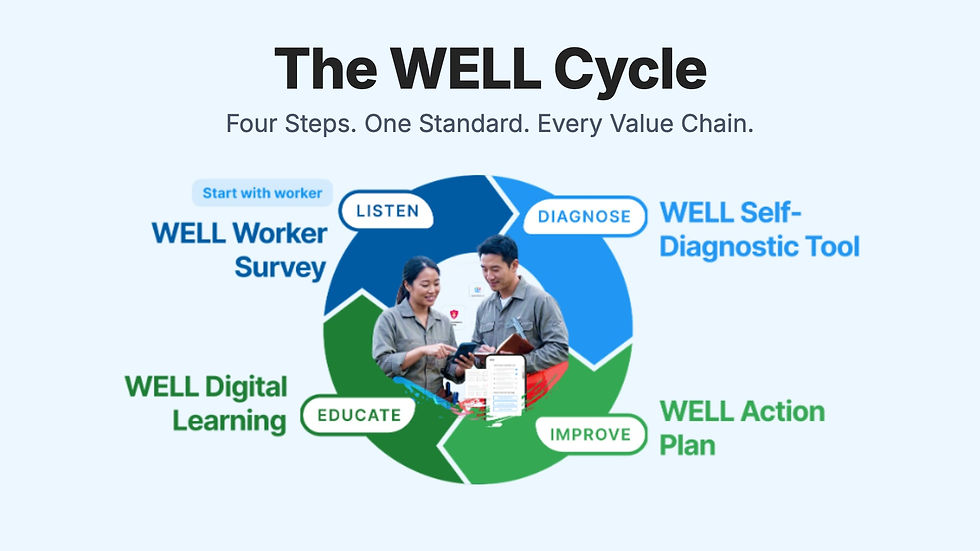
The WELL Cycle takes each question in turn, and the site owns every step. The WELL Grievance Integrity Program does the translation sites find hardest - turning an internationally recognized standard, UNGP Principle 31, into clear indicators, survey questions, and actions that both workers and managers can understand and act on. The Cycle is how that program runs inside a site: Listen, Diagnose, Improve, Educate. Repeat.
Listen - the WELL Worker Survey captures how workers actually experience the grievance mechanism, in their own language. The Grievance Integrity Extension indicators carry the finding - Grievance Mechanism Accessibility, Grievance Mechanism Process + Transparency, and Communication - read alongside the WELL Core indicator Access to Remedy. It goes past a single average to surface the real drivers of low confidence - where workers hesitate, and which groups feel least sure where to turn.
Diagnose - the WELL Self-Diagnostic Tool examines the systems behind those results. Read together with the survey, it shows what is really driving each gap - whether workers simply aren’t yet aware of how the mechanism works, or the mechanism itself needs strengthening, for example a more transparent way of handling cases or a clearly designated person responsible for each step. Each points to a targeted fix.
Improve - with the gaps pinpointed, the site built its own WELL Action Plan of practical, targeted steps, structured as Intended Outcomes. A few examples:
What workers told us | Targeted action the site took |
|---|---|
Workers experience uncertainty and vague routing during follow-up, creating confusion about how complaints are actually processed. | Map and clearly communicate the full reporting pathway - with named contact people - in workers’ own language |
Some workers hesitated to raise more sensitive concerns | Train managers and grievance handlers to respond + handle sensitive issues, and share visible “You Said – We Did” updates so workers see outcomes |
Confidence in the mechanism varied between worker groups | Track how different groups experience and use the mechanism, so access stays even for everyone |
The WELL Action Planner gave the site one structured place to run the plan and hold itself accountable: every action assigned to a named owner, a timeline set, and supporting evidence uploaded as each step was completed. That record is also the evidence trail buyers need for CSDDD Article 16 disclosure - status, owner, deadline, and evidence for every action, visible without waiting for the next survey cycle.
Educate - WELL Digital Learning closed the same gaps from the other side. Workers took Understanding Grievances and Effective Communication. Line leaders took Responding Effectively to Grievances. Managers and practitioners took Implementing Your Grievance Mechanism and Access to Remedy. Every module maps to an indicator the survey flagged, so learning is targeted rather than blanket.
Repeat - a follow-up WELL Worker Survey then checked the only measure that counts - whether the changes showed up in workers’ own experience. The WELL Cycle runs on an annual rhythm - each year’s survey, diagnosis, and action building on the year before. Read together, the WELL Worker Survey, the WELL Self-Diagnostic Tool, and the tracked actions produce WELL Intelligence: a site + portfolio risk view grounded in worker voice, layered with site context and structured self-reflection - ranked by severity, paired with next actions, updated with each improvement.
Worker confidence rose across every part of raising a concern.
The site completed 6 out of 7 planned actions and went back to workers with a second survey. The trend was clear: across every Grievance Integrity indicator, workers reported greater confidence than at baseline - clearer on how to speak up, more assured their concerns would be handled fairly, and more likely to feel heard. The percentage of workers understanding what happens after a concern is reported rose meaningfully and by endline the mechanism met 7 of the 8 UNGP Principle 31 criteria. A mechanism that was already well-built now works better in practice for the people who use it. One priority stays in focus - making sure every worker, in every group, can reach help easily and confidently - and that is exactly what the next cycle is for. This is the strength of the approach: not a one-off project, but a continuous process the site owns, one that keeps surfacing what workers experience, pinpointing where to act, and confirming whether action lands. It also shows why worker engagement is worth the effort - audits tell buyers what sites built, and WELL tells buyers if it is working. And because the Cycle repeats each year, WELL Intelligence compounds - the next survey starts from everything the last one established.
You only know a mechanism works when workers use it.
How do you know whether your grievance mechanism actually works for workers? Not from whether the policy exists - only from whether workers know it, trust it, use it, and see outcomes when they do. The sites that find out are the ones that ask workers directly and treat that feedback as a continuous cycle: Listen, Diagnose, Improve, Educate - then listen again.
Does your grievance mechanism actually work for the workers who depend on it? If you can't yet answer that with evidence, that's where the WELL Grievance Integrity Program begins - turning UNGP Principle 31 into what workers report, a plan your sites own, and proof the changes reached the people who raise concerns.
The next step is a conversation about where to start.