The WELL Cycle: Four Steps. One Standard. Every Value Chain.
Updated: Sep 8
Worker-Driven Due Diligence for responsible, resilient value chains doesn’t start with a policy. It starts with asking workers directly.
The WELL Cycle is how that happens — four connected steps that surface risk, diagnose root cause, drive site-owned action, and build worker and manager capability, year after year. Each step builds on the last. Each cycle compounds the evidence.

Choose Your Program
Before the cycle starts, buyers choose a program. The program isn’t just a survey configuration — it governs the whole cycle. The indicators a program includes are the backbone of every step: what workers are asked in Listen, what the WELL Self-Diagnostic Tool examines in Diagnose, what the WELL Action Plan closes in Improve, and what WELL Digital Learning addresses in Educate.
Six curated programs cover the most common value chain contexts. A seventh lets buyers build their own.
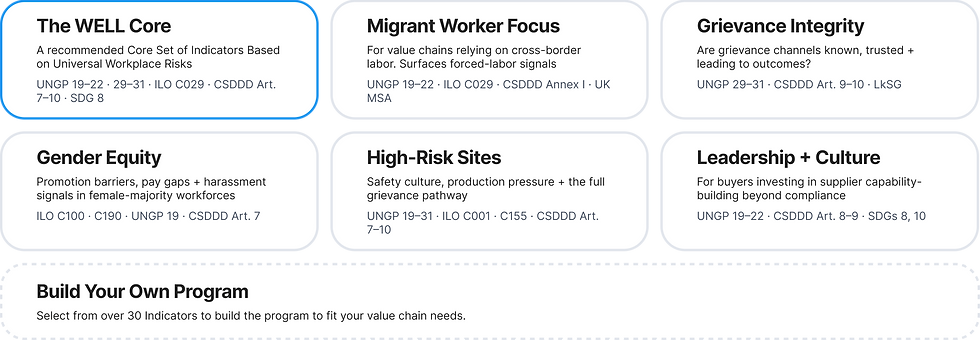
The Core WELL Program is the foundation — eight indicators covering universal workplace risks. Engagement, Fair Pay + Compensation, Professional Development, Occupational Health + Safety, Harassment + Abuse, Communication, Access to Remedy, and Wellbeing. UNGP-aligned, industry-tested, value chain ready. Aligned to UNGP, CSDDD, and ILO core labor standards.
Migrant Worker Focus extends the core for value chains relying on migrant or cross-border labor. It adds Responsible Recruitment, Freedom of Movement, Migrant Worker Equity, Fair Working Hours, and Social Connection — covering forced labor risk, debt bondage, document retention, and access to information in workers’ own languages. Aligned to ILO forced labor and migrant worker conventions. Relevant to CSDDD, UK Modern Slavery Act, and LkSG for buyers with exposure in those jurisdictions.
Grievance Integrity is built for buyers with obligations under UNGP Principle 31. It adds indicators that measure whether grievance channels are known, trusted, accessible, and lead to meaningful outcomes — from awareness through to resolution. UNGP Principle 31 sets eight criteria for what an effective grievance mechanism looks like from a worker’s perspective. This program measures all eight. Relevant to CSDDD operational grievance mechanism obligations and ESRS S2 reporting on grievance effectiveness for value chain workers.
Gender Equity Lens is designed for sectors with high female worker concentration. It extends the core with Gender Equity and Sexual Harassment indicators, surfacing promotion barriers, pay gaps, and conditions that disproportionately affect women workers. Aligned to ILO equal remuneration and harassment conventions. Relevant to ESRS S2 reporting on equal treatment and opportunities across the value chain.
High-Risk Manufacturing covers the full risk picture for Tier 1 and Tier 2 manufacturing sites — safety culture, fair pay, production pressure, overtime, and the complete grievance pathway from worker awareness to resolution. Aligned to ILO working hours and occupational safety conventions. Maps to UNGP and CSDDD due diligence obligations.
Leadership + Culture is for buyers investing in site capability beyond compliance. It extends into management quality, worker voice, social connection, and the conditions that make sustained improvement possible over time. Maps to UNGP and CSDDD obligations on worker engagement and ongoing due diligence.
Build Your Own — buyers who need something more specific can build a program from the full indicator library directly. Core indicators address universal workplace risks and are the foundation of every program. Risk-based indicators extend into specific domains: migrant labor exposure, grievance infrastructure integrity, gender equity gaps, recruitment debt, document retention, and forced labor signals. Impact indicators measure the conditions that drive retention, capability, and long-term improvement — leadership quality, social connection, work-life balance, and housing conditions. Build a global core for comparability across your value chain — then add risk and impact indicators where local conditions demand.
Listen — the WELL Worker Survey
The starting point of every cycle. Workers are surveyed in their language, through channels they trust, in formats designed for low-literacy environments — accessible by QR code, web link, the WOVO app, or trained surveyors.
The survey asks workers about every indicator in their program. Scores are not verdicts — they are signals that open the next conversation.
Diagnose — the WELL Self-Diagnostic Tool
Survey scores open conversations. The WELL Self-Diagnostic Tool is where the conversation gets specific.
Triggered by a site’s three lowest WELL Survey indicators and any salient risks, the Self-Diagnostic Tool is a structured digital assessment for human resources and management teams. Teams answer targeted questions about the systems, policies, and practices behind the survey results — examining the same indicators the workers just scored, from the management side.
The Self-Diagnostic Tool is competency- and maturity-based. It meets sites where they are across three maturity levels: Planning + Intention, Implement + Listen, Engage + Empower. Sites stop at the level that reflects their current state.
This is the step that separates a survey program from a due diligence program. Scores without diagnosis produce defensiveness. Diagnosis without scores produces guesswork. Together, they produce a root cause management can act on — and that buyers can document. For CSDDD and ESRS S2 reporting, the Self-Diagnostic output is part of the evidence that due diligence goes beyond data collection to root cause identification.
Improve — the WELL Action Plan
Worker feedback becomes site-owned action.
The WELL Action Plan is structured as Intended Outcomes — each one closing a specific gap workers surfaced and management diagnosed. Every Intended Outcome ties a competency gap to a corrective action, a verification method, and a communication back to workers.
The plan is site-owned. That distinction matters. A corrective action plan assigned from outside can be ticked as complete on paper while the underlying condition persists. A WELL Action Plan is built from the site’s own diagnosis, with verification that loops back to the workers who raised the concern.
Every WELL Action Plan is paired with matched WELL Digital Learning for workers and managers — so the skills and awareness needed to close the gap are built alongside the structural changes.
Educate — WELL Digital Learning
Workers and managers who understand their rights and responsibilities raise concerns earlier, resolve issues faster, and sustain improvements between survey cycles. Informed workers are twice as likely to raise concerns.
WELL Digital Learning is a library of rights-based modules mapped directly to WELL indicators — developed with the ILO, Better Work, RISE, and IOM, and delivered on any device. Digital Learning is matched to the specific gaps a site’s WELL Action Plan is closing — not deployed as a standalone training.
Repeat The WELL Cycle. Year after year.
Human rights is a practice, not a project.
Each cycle compounds the evidence. Risk findings get more targeted. Actions get sharper. Trajectories, persistent gaps, and cross-portfolio patterns become visible across years. The structured output of the cycle — WELL Intelligence — is a site and portfolio risk view grounded in worker voice, layered with site context and structured self-reflection, ranked by severity, paired with next actions, and updated with each improvement.
That compounding body of evidence is what meets regulatory obligations. UNGP requires buyers to demonstrate that grievance mechanisms actually work from a worker’s perspective — not just that a mechanism exists on paper. CSDDD makes those obligations legally binding for in-scope EU buyers. ESRS S2 turns them into mandated public disclosure, requiring structured worker-voice evidence on who faces greater risk and whether remedy is accessible. The WELL Cycle generates that evidence at each step and builds it year over year.
Interested in learning more or to run the WELL Cycle in your organization?