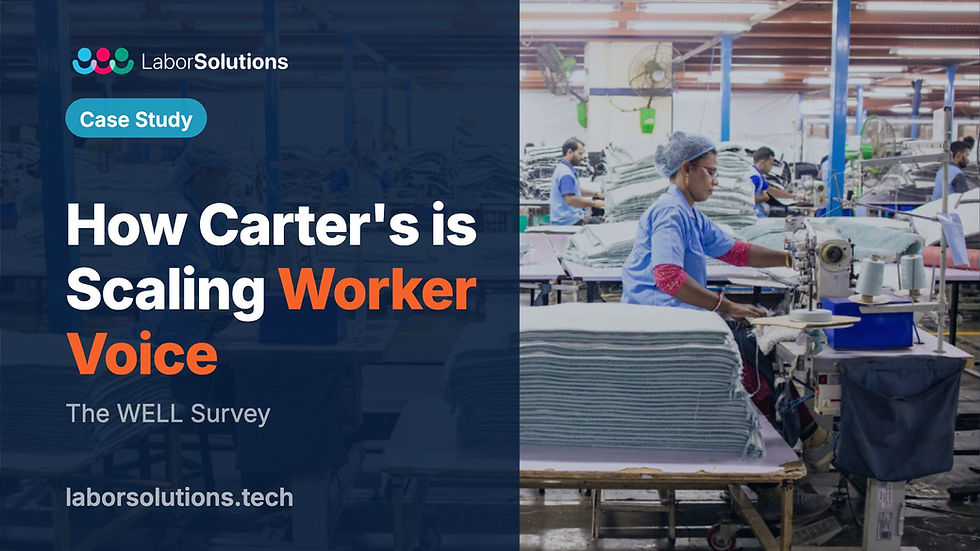
The WELL Survey: Aligning Worker Voice with the UN Guiding Principles and the SDGs
Updated: Sep 17
Regulatory expectations on human rights due diligence are increasing across jurisdictions. The EU Corporate Sustainability Due Diligence Directive (CSDDD) and related legislation make clear that companies must identify, prevent, mitigate, and account for adverse impacts on workers throughout their supply chains.
The UN Guiding Principles on Business and Human Rights (UNGPs) provide the governance framework. The Sustainable Development Goals (SDGs) articulate the social and economic outcomes.
How can companies generate credible, comparable evidence about workers’ lived experience across global supply chains?
The WELL Survey (Wellbeing, Engagement and Livelihoods Survey) was developed to address this gap.
Led by Labor Solutions and co-created through a multi-stakeholder group of brands, advisors, and industry actors - including early contributors such as adidas, H&M, Decathlon, carter’s, Lake Advisory and others - the WELL Survey provides a standardized, modular worker survey framework designed for global benchmarking and local relevance.
It functions as:
A supply chain worker survey
A labor rights survey tool
A human rights due diligence survey
A workforce listening platform
Most importantly, it captures structured, experience-based worker data aligned with internationally recognized standards.
Worker Voice as a Core Element of Human Rights Due Diligence
Under the UNGPs, companies must:
Identify actual and potential human rights impacts
Integrate findings into decision-making
Track effectiveness
Provide access to remedy
Meaningful engagement with affected stakeholders - particularly workers - is central to this responsibility.
The WELL Survey operationalizes that engagement requirement. Rather than assessing policy intent or documentation alone, it collects worker-reported experience across standardized indicators. This enables organizations to evaluate whether management systems function as intended in practice.
The framework directly supports alignment with:
Comprehensive Indicator Framework of the WELL Survey
The WELL Survey includes a standardized Core Questionnaire, with optional modules and limited customization capacity. Each indicator represents a fixed grouping of experience-based questions, ensuring comparability across suppliers, brands, and geographies.
Governance, Voice and Institutional Accountability

Engagement - Worker trust in management, perception of responsiveness
Communication - Access to information and ability to raise questions
Leadership - Fair, inclusive, and accountable management
Access to Remedy - Confidence that concerns are addressed
Grievance Mechanism Accessibility - Safe and barrier-free reporting channels
Grievance Mechanism Process + Transparency - Clear and consistent complaint handling
Freedom of Association - Ability to organize and participate collectively
These indicators align particularly with SDG 8 (worker participation and labor rights) and SDG 16 (transparency, accountability, institutional effectiveness).
Livelihoods, Economic Security and Labor Conditions
Fair Pay + Compensation - Transparent wage calculation and income sufficiency
Fair Working Hours - Predictable schedules and voluntary overtime
Responsible Recruitment - No recruitment fees, clear contracts, absence of debt bondage
Freedom of Movement - No coercion or restriction of employment mobility
Child Labor Prevention - Protection of education and development
These indicators align primarily with SDG 8 (decent work), SDG 1 (income security), SDG 4 (education), and SDG 10 (protection of vulnerable groups).
Equality, Protection and Opportunity

Gender Equity - Addressing structural barriers and ensuring equitable access
Equality (Non-Discrimination) - Equal treatment across demographic groups
Professional Development - Fair access to training and advancement
Harassment + Abuse - Protection from physical and psychological harm
Sexual Harassment - Protection from gender-based violence
These align with SDG 5 (gender equality), SDG 10 (reduced inequalities), and SDG 16 (protection from violence and discrimination).
Health, Safety and Living Conditions

Occupational Health + Safety – Safe working environments and injury prevention
Workplace Climate + Environment – Access to sanitation, water, and dignified facilities
Dormitories + Accommodation – Safe, clean, and adequate housing
Wellbeing – Emotional, physical, and financial health
Family + Work Balance – Policies supporting caregiving and work-life balance
Social Connection – Ability to build relationships and community
These indicators align with SDG 3 (health and wellbeing), SDG 6 (water and sanitation), SDG 11 (adequate housing), and SDG 8 (dignified work).
Standardization with Local Relevance
A persistent challenge in supply-chain worker surveys is duplication and fragmentation. Suppliers are often asked to respond to multiple overlapping surveys, reducing efficiency and worker trust.
The WELL Survey was designed as a shared framework to streamline this landscape.
Its structure includes:
A fixed Core Questionnaire for global benchmarking
Optional modules addressing specific risk areas (e.g., grievance systems, recruitment, working hours)
Up to three custom questions to reflect local priorities
Because each indicator is standardized, results remain comparable across industries and countries while still allowing contextual relevance.
Experience-Based Design and Reporting
The survey uses experience-based questions to encourage candid responses and reduce abstract or perception-only metrics. All surveys are multilingual, supporting accessibility across diverse regions.
Participating organizations receive structured reporting, including:
Indicator rankings
Employee Net Promoter Scores (eNPS)
Demographic breakdowns
Year-over-year tracking
This enables trend analysis, benchmarking, and targeted corrective action planning.
Participating workplaces may also earn the annual WELL Seal, demonstrating commitment to structured worker voice measurement.
From Measurement to Alignment
The SDGs define development objectives. The UNGPs define corporate governance responsibilities.
The WELL Survey provides a structured mechanism to assess whether workplace conditions align with those expectations in practice. It does not duplicate what audits assess — physical facility conditions, policy existence, building safety. It reaches what audits were never designed to access: what workers actually experience.
In an environment where regulators, investors, and consumers increasingly require demonstrable due diligence, structured worker voice is no longer optional. It is a governance necessity.
The WELL Survey was designed to meet that need - through multi-stakeholder collaboration, standardized methodology, and globally comparable indicators. Workplaces improve when worker experience is systematically measured, analyzed, and acted upon.