From Worker Voice to a Framework Mapping Buyers Can Cite
Audits tell buyers what sites built. WELL tells buyers if it's working.
WELL programs are now mapped against leading international frameworks - the UN Guiding Principles and the ILO conventions that national legislation increasingly builds on, making WELL outcomes easily transferable into the evidence buyers need to meet their own requirements.
Selecting an extension on top of the WELL Core Program is what makes a framework mapping possible and the mapping is an outcome of the cycle.

To measure universal workplace risks, every site starts in the same place
Every WELL program runs the WELL Core Program at every site, every cycle — the same four indicators:
Occupational Health + Safety
Harassment + Abuse
Access to Remedy
Engagement
Together they confirm workers were consulted, and the most severe harm categories were checked.
The Core Indicators are sometimes included in the mapping, and are often used as contextual findings. For example, where workers have a low Engagement score, trust is low, indicating they may not have divulged everything in the survey.

To reach the framework mapping they need to cite, buyers choose the depth
Beyond the baseline, buyers choose extensions - indicator sets that deploy together, each built around a leading international framework.
The extensions available today:
Extension | Anchor Framework | Indicators |
|---|---|---|
Grievance Integrity | UNGP Principle 31 | Grievance Mechanism Accessibility + Grievance Mechanism Process + Transparency + Communication (optionally Freedom of Association) |
Fundamental Rights at Work | Freedom of Association, Freedom of Movement, Responsible Recruitment, and Child Labor and Gender Equality | |
Forced Labor + Responsible Recruitment | ILO C29, Forced Labour | Freedom of Movement + Responsible Recruitment + Fair Pay + Compensation + Fair Working Hours (optionally Migrant Worker Equity and Dormitories + Accommodation) |
Fair Wages + Working Hours | Fair Pay + Compensation + Fair Working Hours + Wellbeing | |
Workplace Safety | ILO C155, Occupational Safety and Health | Workplace Climate + Environment + Wellbeing |
Sexual Harassment | ILO C190, Violence and Harassment | Sexual Harassment + Gender Equity |
Worker Welfare | Professional Development + Gender Equity + Fair Pay + Compensation + Workplace Communication + Wellbeing + Social Connection | |
Leadership + Culture | — | carries no anchor framework, so it reports as contextual indicators and doesn't, on its own, qualify a deployment for External Reporting. |
Each extension's criteria are mapped to specific WELL indicators, questions, and findings - a buyer running one gets an assessment built around the criteria their own due diligence already has to answer, not a generic survey with a framework label attached.
Demographic questions are built into every deployment - capturing dimensions such as gender, migrant status, and age - and disparity across those groups gets measured every time. It isn't an extension of its own; it's what keeps a finding honest across groups instead of flattening everyone into an average.
Buyers choose which extensions to run, based on their own risk assessment. Labor Solutions provides the country and sector reference material to inform that choice - but which extensions to deploy is the buyer's decision to make, not ours.
What comes out the other side: evidence buyers can put their name to
Once a site runs the WELL Core Program plus at least one extension, findings stop sitting only in a site report. They become WELL Intelligence - a site and portfolio risk view, ranked by severity and paired with next actions - and from there they turn into structured, buyer-ready disclosure content, organized around the reporting obligation it answers rather than a framework the buyer has to translate on their own:
program scope
worker consultation evidence
findings against the anchor framework
the due diligence response
remediation evidence
Each piece gets built once, from the same worker-driven data, ready to drop into a buyer's own reporting.
And because the WELL Cycle repeats, none of this is a snapshot. Each survey and re-survey adds to what came before, so the evidence deepens cycle over cycle instead of resetting to zero at the next audit window. An audit tells a buyer what a site looked like on the day. WELL Intelligence tells them whether it's getting better - and keeps telling them.
That's the gap between a tool that points at a problem and a program that hands a buyer something they can put their name to.
Interested in how WELL Grievance Integrity maps to UNGP Principle 31 for your value chain? Reach out to the Labor Solutions team.
Human rights is a practice, not a project.
Frequently asked questions
What is the WELL Core Program?
Four indicators — Occupational Health + Safety, Harassment + Abuse, Access to Remedy, and Engagement — deployed at every site in every WELL program. On its own, the WELL Core Program confirms workers were consulted and the most severe harm categories were checked. It doesn't carry an anchor framework.
What is a WELL extension?
A named set of indicators that deploys together and carries an anchor framework — a UNGP Principle or an ILO convention, for example. Buyers pick extensions based on their own risk assessment.
What is the WELL Cycle?
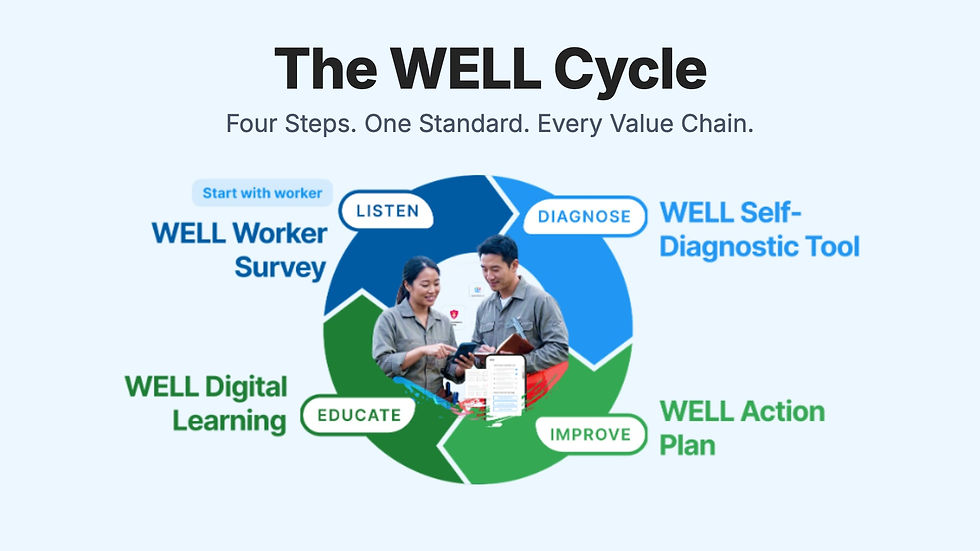
The methodology behind every WELL program: Listen, Diagnose, Improve, Educate, Repeat. The WELL Worker Survey and WELL Self-Diagnostic Tool sit inside Listen and Diagnose; extensions and their framework mappings apply to the same cycle, not a separate process.
How is a WELL extension different from a compliance audit?
An audit checks what a site built against a checklist. A WELL extension asks workers directly, then checks whether the site's own systems can identify and remediate what workers report — and ties both to a named external framework, so the finding is evidence, not just an observation.
What is an anchor framework?
The external standard an extension's findings get mapped against — UNGP Principle 31 for Grievance Integrity, ILO C155 for Workplace Safety, and so on. The framework is satisfied by the extension's full indicator set, not by any single indicator.
How does an extension's mapping work?
Each extension's framework is broken down to the criterion level, with specific WELL indicators, questions, and findings tied to each criterion. That's what lets a finding point back to a named requirement instead of a general theme.
Can a buyer mix and match indicators instead of selecting a full extension?
No. A framework citation needs the full indicator set an extension defines. Individual indicators on their own don't get you there.